
Project Overview & Description
HMIS Digest is a pioneering, natural-language AI application developed by HISP Rwanda to transform how health workers, program coordinators, and decision-makers interact with health management information systems (HMIS).
By connecting directly to a DHIS2 instance via open APIs, HMIS Digest enables users to query complex health databases using everyday language (e.g., “What is the vaccination coverage rate by district this quarter?”). Rather than requiring technical query construction or manual dashboard navigation, the application dynamically generates plain-language insights alongside structured data tables and interactive visual charts. Designed around strict data governance, HMIS Digest supports locally hosted AI models (via Ollama) to ensure complete data sovereignty and keep sensitive health data within the institutional infrastructure.
The Challenge
Despite the wealth of data stored within DHIS2 platforms globally, turning raw health data into timely action remains a persistent bottleneck for health systems:
- Technical Barriers to Data Access: Standard DHIS2 analytics tools require familiarity with query syntax, complex data structures, and dashboard navigation, excluding non-technical health personnel from direct data exploration.
- Delayed Decision-Making: Program focal points often face delays waiting for data managers to compile reports or construct custom visualizations.
- Strict Data Governance & Sovereignty Concerns: Deploying commercial cloud-hosted AI tools risks exposing aggregate national health data to third-party networks, creating regulatory and privacy conflicts for public health authorities.
The Solution
HISP Rwanda designed HMIS Digest to democratize health data analytics through a conversation-driven interface backed by flexible, privacy-conscious architecture:
- Plain-Language Query Engine: Translates simple text questions into accurate DHIS2 analytics requests, instantly returning contextual interpretations, mathematical aggregations, and charts.
- Transparent Step-by-Step Reasoning: Provides full transparency by displaying the AI’s step-by-step logic—such as searching metadata, resolving organizational units, and executing database queries—before displaying the final answer.
- Dual-Architecture Deployment for Data Governance:
- Local AI Execution (Ollama): Operates entirely within the institution’s local infrastructure. Questions, DHIS2 metadata, and query results never leave the local environment.
- Cloud-Hosted Model Option: Supports frontier models (e.g., GPT, Claude) for environments where organizational data governance permits external processing of aggregate data.
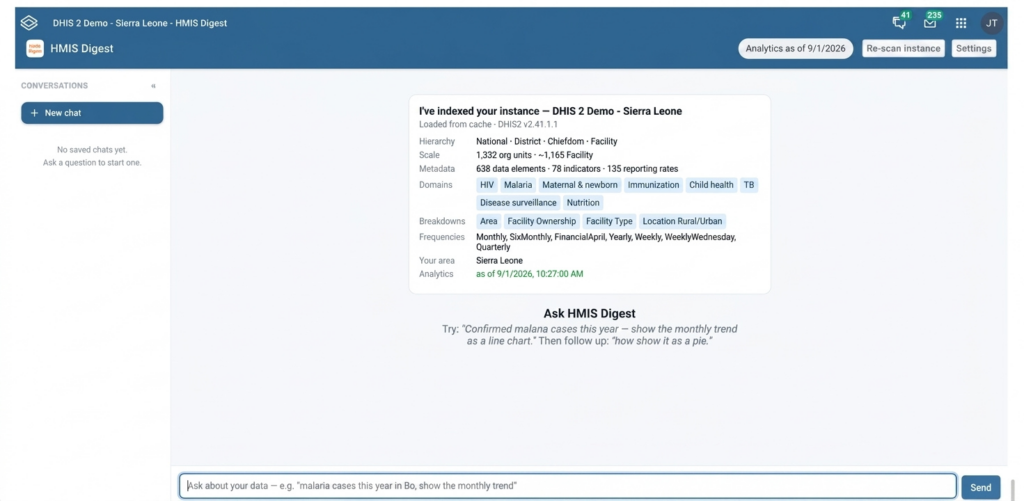
The HMIS Digest home screen – after connecting, the app summarizes the DHIS2 instance (the DHIS2 Sierra Leone demo) and invites a plain-language question.
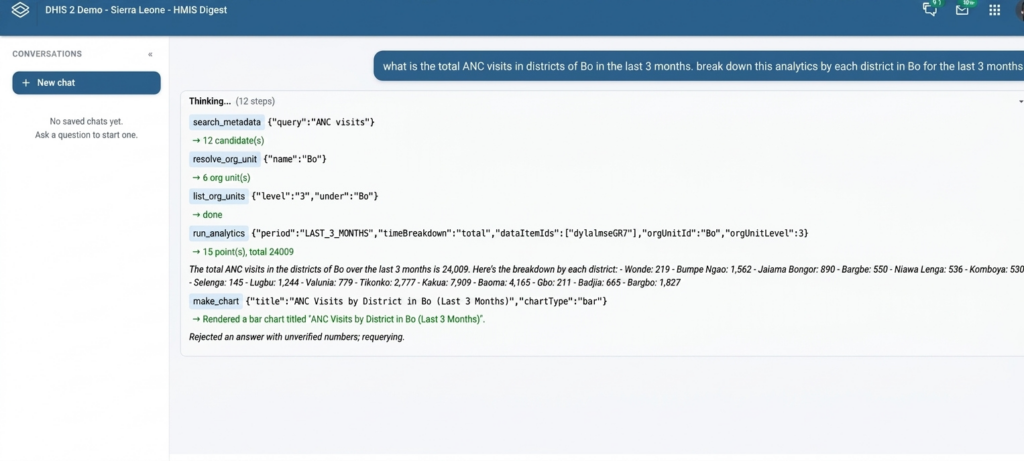
The assistant’s step-by-step reasoning – searching metadata, resolving org units, and running analytics; shown transparently before it answers.
Approach & Evaluation Strategy
To validate the application’s real-world readiness, HISP Rwanda conducted a structured pilot evaluation covering 18 distinct criteria across six core domains:
| Evaluation Domain | Performance & Pilot Outcomes |
| Functionality & Access | Excellent: Reliable, friction-free connections established with tested DHIS2 instances. |
| Usability & UX | Good: Intuitive interface; non-technical users navigated and initiated queries without specialized training. |
| Natural Language Understanding | Good: Successfully interpreted everyday questions without requiring technical syntax. |
| Accuracy & Calculations | High Reliability: Aggregations, percentages, averages, and trend lines calculated accurately on clearly configured indicators. |
| Relevance of Output | Relevant: Generated meaningful, contextual readings whenever requested indicators were correctly identified. |
| Technical Performance | Needs Optimization: Latency during complex queries highlighted the need for infrastructure and engine optimizations. |
Overall Assessment: Testers rated the concept and current state as “Acceptable”—validating the core value proposition while establishing clear benchmarks for refinement.
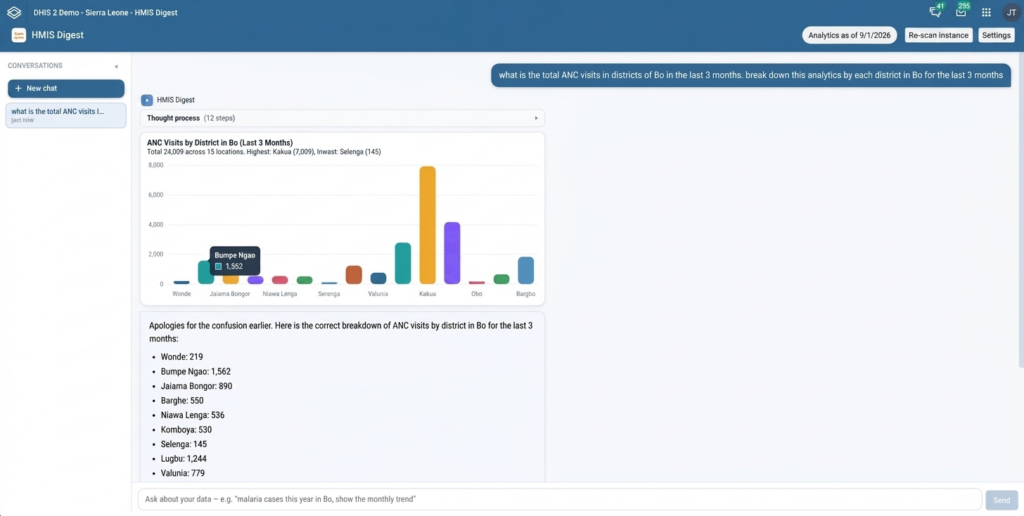
A generated answer – ANC visits by district in Bo, rendered as a bar chart with the supporting breakdown.
Way Forward & Roadmap
In alignment with the broader DHIS2 AI ecosystem, HISP Rwanda is actively executing a target roadmap based on pilot feedback:
- Strengthen Data Retrieval & Query Interpretation: Enhance indicator mapping so the query engine precisely matches user questions to complex DHIS2 metadata configurations without requiring rephrasing.
- Refine Sub-National Visualizations: Improve district-level chart rendering and integrate interactive filtering options to support granular, local-level analysis.
- Optimize Technical Performance: Restructure backend execution and local model inference to significantly reduce current response times (~105 seconds for complex queries) to seamlessly fit daily workflow paces.
- Iterative Deployment & Testing: Deploy engine optimizations followed by a second round of structured pilot testing with public health stakeholders.