
Background
In the push toward universal health coverage, one constant remains clear: access to healthcare means very little without quality of care. Across Rwanda, keeping hospital standards high, patient safety robust, and clinical operations compliant is a national priority.
Historically, tracking quality standards across dozens of regional and district hospitals required heavy logistics, mountains of paper assessments, and long waiting periods before decision-makers could act on findings.
To bridge this gap, HISP Rwanda, in close collaboration with the Ministry of Health, introduced a game-changing digital health initiative: The Rwanda Hospitals Accreditation Platform.
The Pre-Digital Challenge: Paper-Based Bottlenecks
Prior to digitizing the accreditation lifecycle, survey teams faced significant operational friction. Evaluating a hospital meant carrying stacks of physical evaluation sheets, manually compiling scores into isolated spreadsheets, and physically mailing or emailing reports to program coordinators.
This traditional approach created several systemic hurdles:
Fragmented Data Storage: Critical compliance evidence remained trapped in disconnected files, making multi-year trend analysis nearly impossible.
Delayed Feedback Loops: Weeks often passed between an on-site audit and the final evaluation report, delaying vital corrective actions.
Limited System-Wide Visibility: Ministry officials lacked a real-time, bird’s-eye view to benchmark facilities, spot national-level quality gaps, or direct resources where most needed.
Enter the Rwanda Hospitals Accreditation Platform
Built on the globally trusted DHIS2 software framework, the platform transitions the entire national accreditation framework into an agile, paperless, real-time ecosystem. Assessors now step into health facilities equipped with smart digital tools that enforce consistent evaluation logic and deliver instant insights.
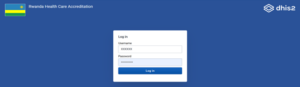
DHIS2-Based Rwanda Health Care Accreditation Platform Login page
The Rwanda Hospital Accreditation Platform provides digital accreditation assessment functionalities that allows surveyors to conduct evaluations across Rwanda’s health facilities using electronic assessment forms aligned with national accreditation standards. The platform supports multiple standards sets within different risk areas, allowing assessors to evaluate and score different levels of effort for each standard through predefined scoring rules.
This simplifies data collection processes, improves consistency in accreditation scoring, and reduces dependence on paper-based tools and manual reporting activities.
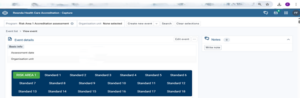
Interface for accessing different standards assessment Forms
- Automated scoring and evaluation
The platform provides automated scoring and evaluation functionalities that automatically calculate assessment scores based on predefined scoring rules, reducing manual calculation errors, and improving assessment accuracy. It also enables rapid generation of accreditation results, performance summaries, and evaluation reports immediately after assessment completion, supporting timely reporting and decision-making processes.
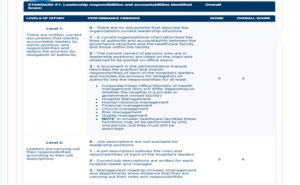
Accreditation assessment scoring form
- Real-time analytics and dashboards
The platform provides interactive real-time dashboards and analytics functionalities that give hospitals, assessors, and the Ministry of Health the visibility into accreditation performance across healthcare facilities. Users can analyze hospital performance scores, compare facility performance, monitor compliance levels, and review national accreditation summaries to support data-driven decision-making and continuous quality improvement initiatives.

Accreditation dashboard showing average scores by risk area and assessment level
- Centralized reporting and monitoring
The platform centralizes accreditation data within a single digital environment accessible to authorized stakeholders, supporting national-level monitoring, hospital performance tracking, and coordinated reporting processes. This improves visibility, collaboration, and coordination among hospitals, assessment teams, program teams, and decision-makers.
- Secured role-based access
The platform provides secured role-based access functionalities that ensure information is only accessible by authorized users based on their responsibilities and permissions within the accreditation process. Different user roles are assigned appropriate access levels to support secured data management, confidentiality, and controlled participation in assessment, review, validation, and reporting activities.
Benefits for Rwanda’s health sector
The implementation of the Rwanda Hospitals Accreditation Platform provides important benefits for managing accreditation activities across Rwanda’s healthcare system.
- For the Ministry of Health Rwanda, the platform improves visibility of accreditation performance across hospitals and health facilities while supporting monitoring, reporting, and decision-making through centralized dashboards, analytics, and data visualization tools.
- For hospitals and healthcare facilities, the platform simplifies accreditation assessment and reporting processes, improves access to accreditation performance information, and supports continuous quality improvement activities through electronic data collection, dashboards, analytics, and reporting functionalities supported by the DHIS2 platform. [4]
Conclusion
The Rwanda Hospital Accreditation Platform represents an important step toward strengthening healthcare quality management and accreditation processes within Rwanda’s health sector.
By replacing fragmented manual processes with a centralized digital solution, the platform improves operational efficiency, enhances visibility of accreditation performance, and supports more coordinated and evidence-based decision-making.
Through continued collaboration between HISP Rwanda, the Ministry of Health Rwanda and Health facilities (hospitals ), the platform continues to support ongoing efforts aimed at improving healthcare quality and strengthening health systems across Rwanda. END
References
[1] | Rwanda Agency for Accreditation and Quality Health Care, “Rwanda Hospital accreditataion survey result,” [Online]. Available: https://raaqh.org.rw/accreditation/. |
[2] | M. o. H. Rwanda, “Rwanda Hospital Accreditation Standards,” Rwanda, Ministry of Health, KIGALI, 2022. |
[3] | M. S. f. H. Health, “Executive Summary Report for 51 Hospitals Accreditation Survey,” Management Sciences for Health, KIGALI, 2023. |
[4] | Analyze, “DHIS2,” [Online]. Available: https://dhis2.org/features/analyze/. [Accessed 21 May 2026 2026]. |